QUATORZIÈME CONFÉRENCE MINISTÉRIELLE
Post-MC14 Briefing note
Subventions à la pêche
The WTO Agreement on Fisheries Subsidies establishes new, binding, multilateral rules for curbing harmful subsidies, which are a key factor in the widespread depletion of the world’s fish stocks. Adopted at the WTO’s 12th Ministerial Conference (MC12) in June 2022, the WTO Agreement on Fisheries Subsidies entered into force after two-thirds of WTO members submitted their instruments of acceptance. This threshold was reached on 15 September 2025.
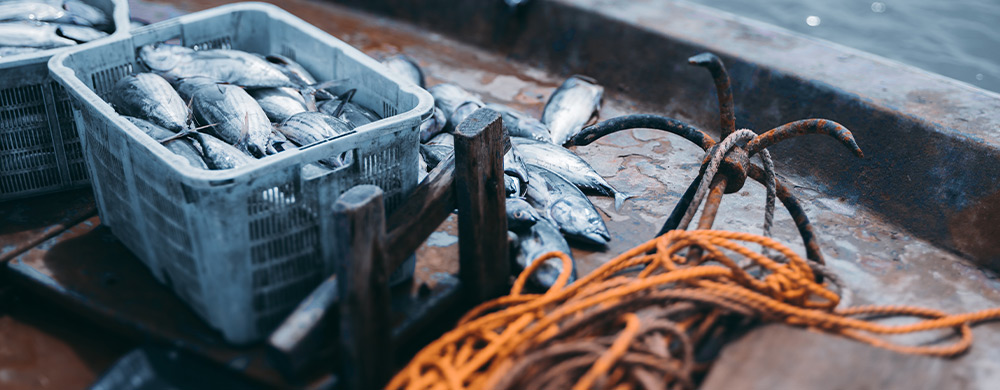
The Agreement on Fisheries Subsidies is the WTO's first multilateral agreement with environmental sustainability at its core. It prohibits the worst forms of harmful fisheries subsidies that support illegal fishing activities and overexploitation of stocks. It will help to protect the world’s fish stocks and the livelihoods of hundreds of millions of peoples who depend on fisheries for food, income and employment.
Ministers marked the Agreement's entry into force at a ceremony held in Yaoundé, Cameroon, during the 14th Ministerial Conference (MC14).
At the MC14 opening ceremony held on 26 March, Paraguay, Samoa, and Saint Vincent and the Grenadines deposited their instruments of acceptance, bringing the total number of instruments received to 119. The full list can be found here.
At MC12, WTO members also agreed to continue negotiating on outstanding fisheries subsidies issues with the aim of finding consensus on additional provisions to further strengthen the disciplines on fisheries subsidies. The negotiations are ongoing in the Negotiating Group on Rules under the chairmanship of Ambassador Leslie Ramsammy of Guyana. At a meeting on 6 February 2026, the chair reported on his bilateral consultations with members and noted a strong and shared determination to resume negotiations on outstanding disciplines as soon as practicable. At MC14, ministers agreed to continue to engage in negotiations on fisheries subsidies, with the aim of making recommendations to the 15th Ministerial Conference to achieve the comprehensive disciplines on fisheries subsidies referred to in Article 12 of the Agreement on Fisheries Subsidies.
Why is the WTO Agreement on Fisheries Subsidies important?
In 2021, 35.5 per cent of global fish stocks were overfished compared with 10 per cent in 1974.(1) It is estimated that governmental subsidies to marine fishing activities total USD 35 billion per year globally.(2) Of this amount, around USD 22 billion are considered harmful, contributing to the depletion of marine stocks.
The total economic losses caused by illegal, unreported and unregulated (IUU) fishing are estimated to be as high as USD 50 billion.(3) The expected resources unlocked by the Agreement could be redirected to promote and support sustainable fisheries management practices by all WTO members, including developing and least-developed country (LDC) members.
What are the benefits of the Agreement?
1. The Agreement prohibits harmful fisheries subsidies to protect peoples? livelihoods and to promote food security.
2. The Agreement reinforces the multilateral trading system.
3. The Agreement supports a global endeavour to achieve a more sustainable planet.
4. The Agreement takes into account the needs of developing and LDC members.
5. The Agreement supports the sustainable future of our shared oceans.
Following the entry into force of the Agreement, the Committee on Fisheries Subsidies was established to oversee implementation of the Agreement. WTO members elected Ana Laura Lizano Flores of Costa Rica as its first chair in December 2025 and held the first regular meeting of the Committee on 1 May 2026, marking a milestone in the implementation of the Agreement on Fisheries Subsidies. They approved various decisions on the functioning of the Committee . The Committee is responsible for examining all information submitted by members according to notification requirements. It will also review annually the operation and implementation of the Agreement and will serve as a platform for members to maintain regular dialogue on their subsidized fishing practices. This will help centralize fisheries subsidies information and increase transparency of governments’ practices. Information on members’ subsidies schemes will also be made available to the public.
A brochure explaining the benefits of the Agreement is available here.
WTO Fisheries Funding Mechanism ("Fish Fund")
The WTO Fisheries Funding Mechanism, known as the "WTO Fish Fund", was established under Article 7 of the Agreement on Fisheries Subsidies to provide targeted technical assistance and capacity-building to help developing and least-developed country members implement the Agreement.
The Fish Fund provides support by awarding grants for technical assistance and capacity-building needed to implement the new obligations and disciplines contained in the Agreement. To date, 18 members have contributed and committed almost CHF 16 million, the equivalent of more than USD 20 million to the WTO Fish Fund.
The Fund's second Call for Proposals, launched on 2 February 2026, closed on 8 May. The Fish Fund Secretariat is currently reviewing applications received. The Fish Fund typically runs two calls for proposals per year, with the next call expected later in 2026.
The Fish Fund Steering Committee approved 26 requests for project grants following the first Call for Proposals - totalling USD 2.9 million.
Eligible members wishing to apply are encouraged to consult the application portal and supporting resources available on the Fish Fund website, which provides detailed guidance on eligibility criteria, grant types and the application process.
For further information on the Fish Fund, eligibility and upcoming calls for proposals, please visit the www.wtofishfund.org. For direct inquiries, contact the Fish Fund Secretariat at [email protected].
Footnotes
- Sharma, R. et al., eds. (2025), Review of the state of world marine fishery resources – 2025, FAO Fisheries and Aquaculture Technical Paper, No. 721, Rome: FAO, https://doi.org/10.4060/cd5538en. Back to text
- Rashid Sumaila, U. et al. (2019), “Updated estimates and analysis of global fisheries subsidies”, Marine Policy Volume 109, 103695, https://doi.org/10.1016/j.marpol.2019.103695. Back to text
- Sumaila, U.R. et al. (2020), “Illicit trade in marine fish catch and its effects on ecosystems and people worldwide”, Science Advances 6, eaaz3801, https://doi.org/10.1126/sciadv.aaz3801. Back to text