


E-Commerce
Agreement on Electronic Commerce
The Agreement on Electronic Commerce (ECA) establishes the world's first baseline set of global digital trade rules, aimed at facilitating cross-border digital trade, fostering an open digital environment, promoting trust in online transactions, and supporting an inclusive digital economy. The E-Commerce Agreement is open to all WTO members to join.
News
In order to bring the ECA into force, on 28 March 2026, 67 WTO members – covering approximately 70% of global trade – adopted a clear and immediate pathway to bring into force the E-Commerce Agreement through interim arrangements. In parallel, the ECA continues to welcome new co-sponsor WTO Members, and the participating members will continue to work towards incorporating the E-Commerce Agreement into Annex 4 of the Marrakesh Agreement, and to encourage all WTO members to join the E-Commerce Agreement. The full text of the ECA with interim arrangements may be found here.
The 68 WTO Members who have undertaken the Interim Arrangements will proceed with their respective domestic procedures. The ECA will enter into force for those Members that have accepted it, after 45 members have deposited their instruments of acceptance.
With digital transactions linked to over 60% of global GDP, many members believe that there is an urgent need to implement global digital trade rules that allow businesses and consumers to seize the benefits of digital trade. WTO and OECD research shows that not implementing the ECA leaves around US$ 159 billion worth of trade on the table every year. If implemented by all WTO members, the ECA would boost global GDP by US$ 8.7 trillion by 2040, with low- and lower middle-income economies projected to reap the most benefits.
WTO Director-General Ngozi Okonjo-Iweala:
Digital trade is an exciting frontier for driving economic growth and job creation. By moving forward with the E-Commerce Agreement, participating economies are helping to establish a shared regulatory framework that can lower costs and unlock new opportunities. They are also demonstrating that the multilateral trading system can respond, and is responding, to new challenges and changing economic circumstances. Continued cooperation is vital to ensure that digital trade remains open and predictable, and that its benefits are shared across economies at all levels of development
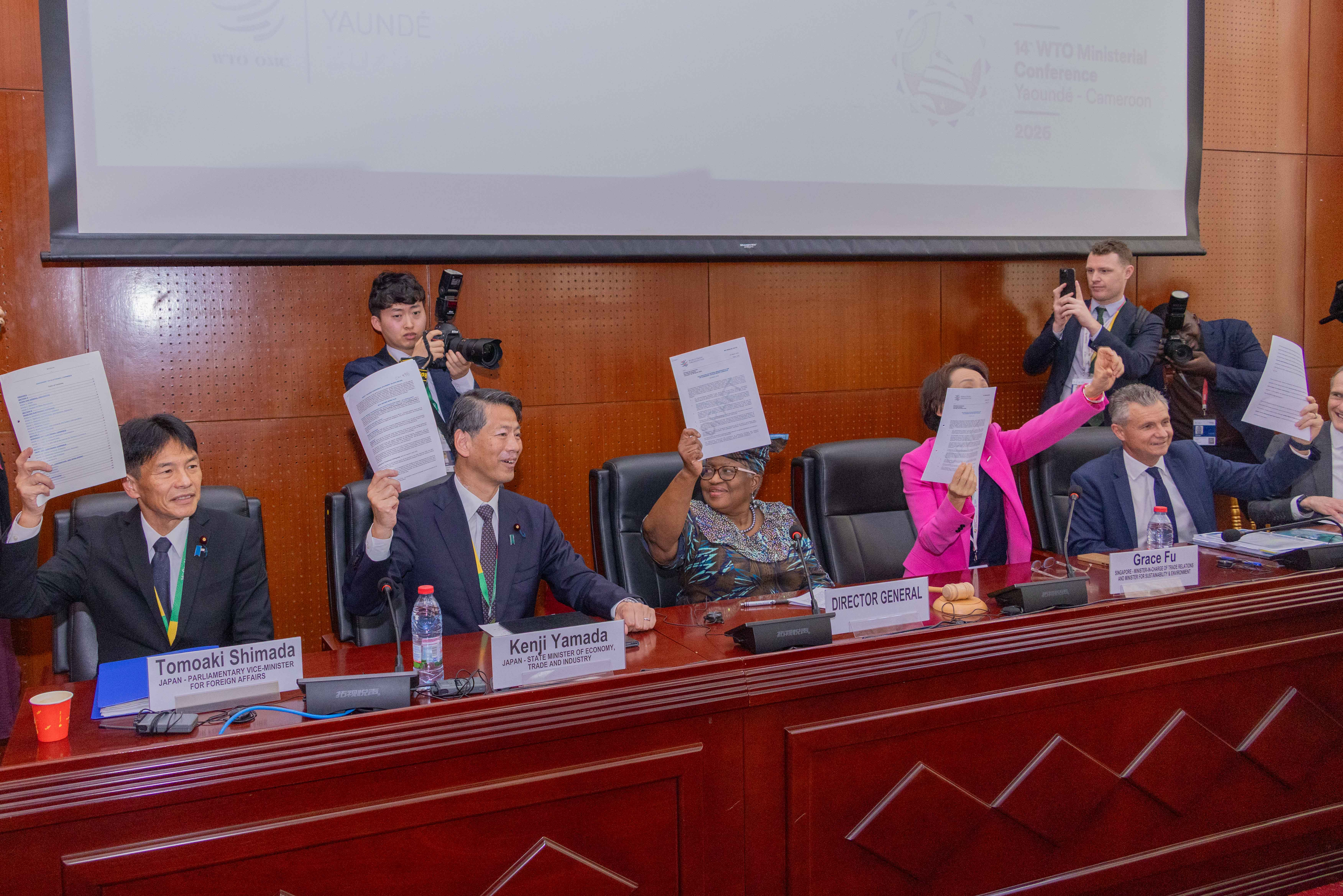
Ministerial Session on E-Commerce Agreement
Ministerial Session on E-Commerce Agreement
Ministerial Session on E-Commerce Agreement
Background on the Agreement on Electronic Commerce
At the 11th Ministerial Conference in December 2017, a group of 72 WTO members launched the Joint Statement Initiative (JSI) on E-Commerce by agreeing to initiate exploratory work towards future WTO negotiations on trade-related aspects of e-commerce (WT/MIN(17)/60).
In January 2019, 77 WTO members confirmed their intention to commence these negotiations, agreeing to “seek to achieve a high standard outcome that builds on existing WTO agreements and frameworks with the participation of as many WTO members as possible” (WT/L/1056).(1)
In December 2024, following five years of negotiations, 72 co-sponsors circulated the concluded text of the E-Commerce Agreement and expressed their shared objective of seeking a decision at the General Council to incorporate it into the WTO legal architecture, pursuant to paragraph 9 of Article X of the Marrakesh Agreement Establishing the World Trade Organization (WT/GC/W/955). The latest request for incorporation and list of members supporting the ECA can be found in WT/GC/W/963/Rev.1.
The initiative is jointly co-convened by H.E. Mr. James Victor Baxter (Australia), H.E. Mr. NAGAI Katsuro (Japan) and H.E. Mr. TAN Hung Seng (Singapore).
For more information on the E-Commerce Agreement and its impact, please refer to the Information Package and the Working paper - Great expectations: Quantifying the potential economic impact of the WTO Agreement on E-Commerce.
Capacity building framework
Co-conveners of the Joint Statement Initiative on E-commerce – Australia, Japan and Singapore – have published a Capacity Building Framework, a non-exhaustive list of available capacity building initiatives and programmes in support of developing and least-developed countries' efforts to harness the opportunities offered by digital trade.
Documents
Footnotes
- WTO members participated in these discussions, accounting for over 90 per cent of global trade participated in these discussions, accounting for over 90 per cent of global trade Back to text
Problems viewing this page? If so, please contact [email protected] giving details of the operating system and web browser you are using.