14TH MINISTERIAL CONFERENCE
Post-MC14 Briefing note
Agriculture
Trade in food and agriculture was among the topics that were high on the agenda when WTO members met for the 14th Ministerial Conference (MC14) in Yaoundé.
In the run-up to MC14, WTO members tabled several new submissions on agriculture, trade and food security aimed at providing ministerial guidance on how to revitalize the agriculture negotiations and overcome persisting stalemate.
On 27 February 2026, the Chair of the agriculture negotiating body, Ambassador Ali Sarfraz Hussain (Pakistan), tabled a draft text building upon the elements contained in members' proposals.
Following consultations with members, he then circulated a revised draft reflecting their comments.
The Chair indicated that the draft text seeks to reflect elements raised in members' proposals and discussions. Most members indicated that the text could serve as a basis for further discussion, while a small number of members stated that they were unable to support it in its current form.
Ministers discussed agriculture issues at MC14 in a plenary session, with the Chair providing guided questions to help frame the discussion during the session.
MC14 outcome and the path ahead
The ministerial session on agriculture at MC14 featured a robust and lively discussion among members, with 78 interventions responding to the Chair's guiding question on the causes for the current impasse in the agriculture negotiations, and how these could be overcome.
Members were also asked to share their views on the draft Ministerial Declaration on Agriculture, Trade and Global Food Security. The report by the Minister Facilitator on these discussions is available here.
Despite intense engagement among delegations during meetings, WTO members were unable to reach consensus on the draft Ministerial Declaration.
In statements to the plenary session, several members expressed disappointment with the limited progress on key issues to date and encouraged new approaches in future negotiations. Many emphasized the centrality of food security, while others reaffirmed their commitment to continue substantive discussions when reconvened back in Geneva.
Upon returning to Geneva at the General Council in May, several members reiterated the importance of agriculture and food security and welcomed the announcement by the Chair to keep discussions alive in subsequent meetings.
Background
Since WTO negotiations on agriculture began in 2000, the value of agricultural trade has grown approximately five-fold – from USD 300 billion to USD 1,494 billion in 2024.
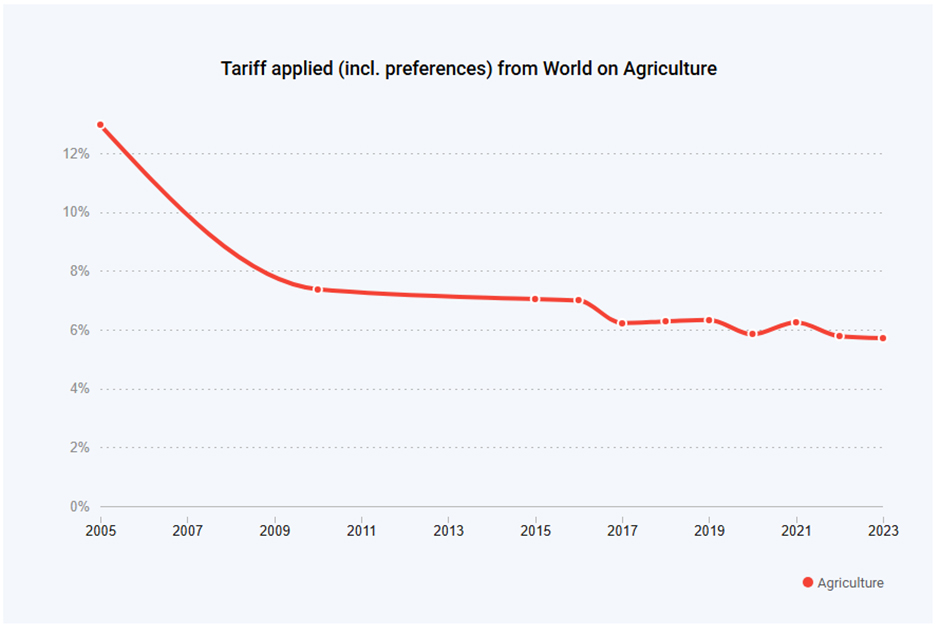
Barriers to agricultural trade have also fallen significantly. The average applied tariff on agricultural goods (including trade preferences) dropped from 13% in 2005 to 5.7% in 2023.
Source: SDG Trade Monitor
However, markets for food and agriculture remain highly distorted. The Organisation for Economic Cooperation and Development has found that support to individual producers amounted to USD 624 billion per year on average in the 2022-24 period, including both budgetary outlays and transfers due to border measures such as tariffs.
Rules and commitments
The Uruguay Round talks led to the first major multilateral trade agreement covering specifically agricultural products – as well as a separate agreement on sanitary and phytosanitary (SPS) measures, covering food safety and plant and animal health.
The Agreement on Agriculture sets out rules governing trade in agricultural goods, and includes specific commitments which WTO members have said they will respect, including on market access barriers such as tariffs; support to WTO members' domestic farm sectors; agricultural export subsidies and other measures such as export restrictions.
Unfinished business
In the Preamble to the Agreement, WTO members reiterated that their long-term objective was a "fair and market-oriented agricultural trading system".
However, they also recognised that more needed to be done to achieve this goal.
In Article 20 of the Agreement, WTO members agreed that negotiations would continue. The article also sets out what other considerations should be taken into account by the organization's members in the talks.
When the Doha Round of trade talks was launched in 2001, the ongoing talks on agriculture were included alongside many other new negotiating topics.
At the Nairobi Ministerial Conference in 2015, WTO members agreed there was no consensus on whether to reaffirm the Doha negotiating mandates.
However, at the conference WTO members did agree to eliminate agricultural export subsidies and put in place disciplines on other measures considered to have comparable effects.
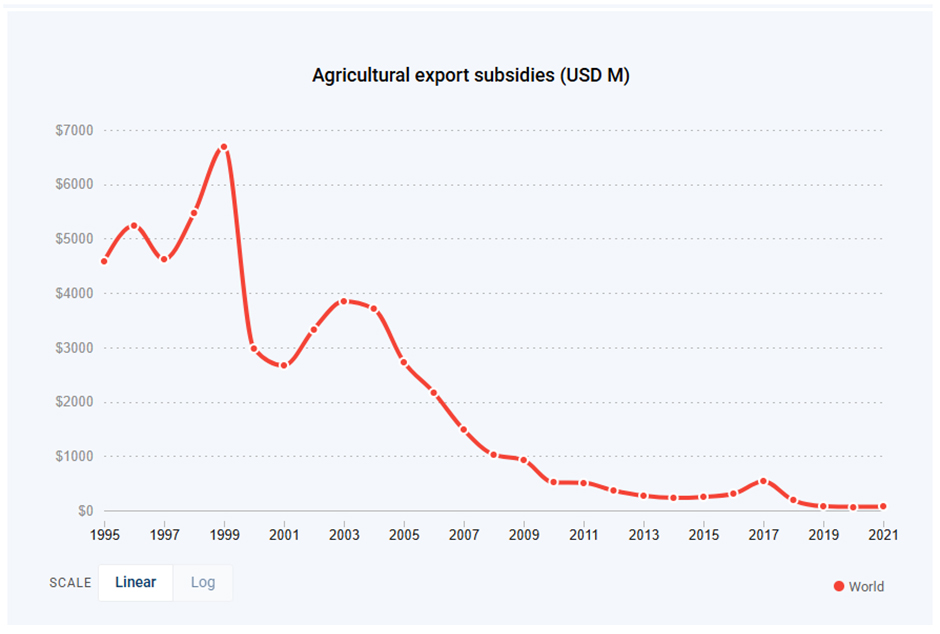
As a result of several policy reforms in several major economies and the Nairobi Decision, the use of export subsidies fell from a peak of almost USD 6.7 billion in 1999 to around USD 70 million notified in 2021.
Source: SDG Trade Monitor
WTO members also agreed in 2013 a ministerial decision related to government food purchases for public stocks at administered prices, referring to minimum procurement price set by public authorities. WTO members agreed, under certain conditions, not to challenge these programmes under the Agreement on Agriculture through the organization's dispute settlement process, in exchange for additional information about how these programmes operated. They also committed to negotiating a "permanent solution" to the problems some developing countries said they faced in this area.
Better functioning markets
Concerns about trade and food insecurity remain high on the WTO agenda. At their 12th Ministerial Conference in 2022, WTO members concluded a landmark declaration on the topic. In their declaration, members recognized that trade, along with domestic production, plays a vital role in improving global food security in all its dimensions and enhancing nutrition. They also committed to take "concrete steps" to facilitate trade and improve the functioning and long-term resilience of global markets for food and agriculture.
They also adopted a decision on export restrictions and humanitarian food aid, as well as the Agreement on Fisheries Subsidies and a separate declaration on SPS measures.
Finding a way forward
WTO members were unable to reach consensus on food and agriculture at the organization's 13th Ministerial Conference in Abu Dhabi.
While some WTO members wanted to fast-track progress on specific topics, others favoured a comprehensive approach that would address all outstanding issues as a single package.
Since the Ministerial Conference, WTO members have explored possible ways forward that could allow them to bridge the differences in their positions.
New tensions related to trade and other issues have complicated the challenge of making progress.