

E-Commerce
Work Programme on E-Commerce, Moratorium
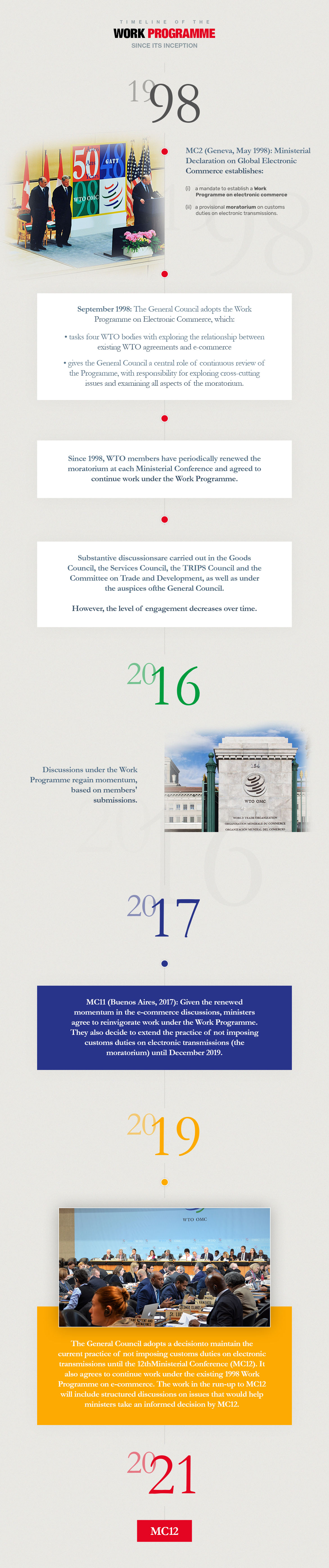
The Work Programme on Electronic Commerce, adopted by the General Council in September 1998, tasks four WTO bodies with exploring the relationship between existing WTO agreements and e-commerce. It gives the General Council a central role of continuous review of the Programme, with responsibility for exploring cross-cutting issues and examining a provisional moratorium on customs duties on electronic transmissions. The overall objective is to examine all trade-related aspects of e-commerce and to give recommendations for further action.
Since 1998, ministers have regularly extended the Work Programme on Electronic Commerce and the moratorium. However, as members were unable to reach consensus on a decision at the 14th Ministerial Conference (MC14), the Work Programme and the moratorium lapsed on 30 March 2026. Nevertheless, efforts continue in Geneva with a view to exploring the way forward.
News
Origin of the Programme
In response to the growing importance of e-commerce, ministers adopted the Declaration on Global Electronic Commerce at the Second Ministerial Conference in May 1998. The Declaration called for:
- the establishment of a work programme
- a provisional moratorium on customs duties on electronic transmissions
In September 1998, the General Council adopted the Work Programme on Electronic Commerce to examine trade-related issues relating to global e-commerce.
Documents
What is e-commerce?
The Work Programme on Electronic Commerce states: “Exclusively for the purposes of the work programme, and without prejudice to its outcome, the term 'electronic commerce' is understood to mean the production, distribution, marketing, sale or delivery of goods and services by electronic means”.
Where is the Work Programme conducted?
The Work Programme instructed four WTO bodies to explore the relationship between existing WTO agreements and e-commerce:
- the Council for Trade in Services examines and reports on the treatment of e-commerce in the legal framework of the General Agreement on Trade in Services;
- the Council for Trade in Goods examines and reports on aspects of e-commerce relevant to the provisions of the General Agreement on Tariffs and Trade (GATT) 1994, the multilateral trade agreements covered under Annex 1A of the WTO Agreement and the approved work programme;
- the Council for Trade-related Aspects of Intellectual Property Rights (TRIPS) examines and reports on the intellectual property issues arising in connection with e-commerce;
- the Committee on Trade and Development examines and reports on the development implications of e-commerce, taking into account the economic, financial and development needs of developing countries.
What is the role of the General Council?
The General Council keeps the Work Programme under continuous review. In addition, it explores trade-related issues of a cross-cutting nature and examines all aspects of the Work Programme concerning the imposition of customs duties on electronic transmission.
Between 2001 and 2016, the General Council's examination of cross-cutting issues was carried out in dedicated discussions. After 2016, discussions continued in informal meetings open to all members convened by the General Council Chair and through reviews in the General Council. More information on these discussions is available here.
In 2015, the Secretariat circulated a background note providing a summary of the activities of the bodies charged with implementing the Work Programme. This was updated in 2016.
Work under the Work Programme on E-Commerce intensified following MC12 and MC13 decisions, which called for the reinvigoration of the Work Programme with particular emphasis on its development dimension. The decisions also requested members to intensify discussions on the scope, definition and impact of the moratorium. Work resumed in dedicated discussions addressing specific issues identified by members, including issues related to the moratorium. The MC13 Decision also indicated that the moratorium and Work Programme would expire at MC14 or on 31 March 2026, whichever is earlier. At MC14, despite concerted efforts, members were unable to adopt a decision to extend the Work Programme and the moratorium.
Moratorium on customs duties on electronic transmissions
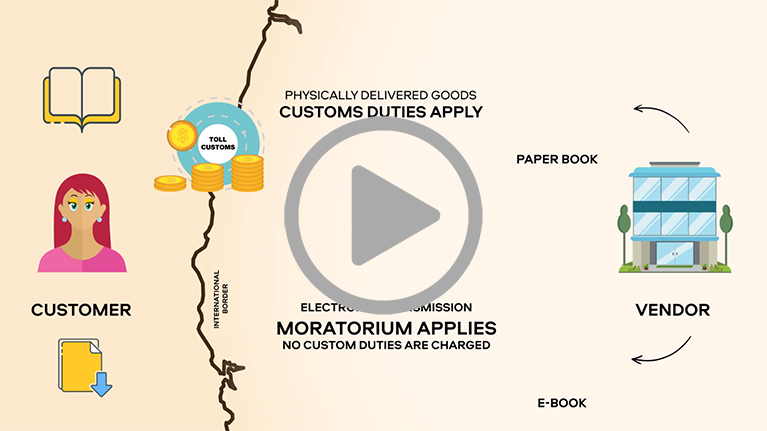
Products that were always traded physically are now increasingly traded digitally, with streaming services progressively taking the place of CDs or DVDs and with e-books witnessing growing demand. Customs duties are usually applied by WTO members on imported goods but since 1998 they have agreed not to impose tariffs on electronic transmissions.
The moratorium on customs duties on electronic transmissions was first adopted at the Second WTO Ministerial Conference in 1998 and has been regularly extended, together with the Work Programme. As members were unable to reach consensus on a decision at MC14, the moratorium lapsed on 30 March 2026, together with the Work Programme. A provision on not imposing customs duties on electronic transmissions is contained in the Agreement on E-commerce (ECA). In addition, a group of members issued
a joint statement confirming their intention to continue not imposing customs duties on electronic transmissions amongst themselves.
Overview of work since 1998
The evolution of technology: past, present and future

Did you know?